
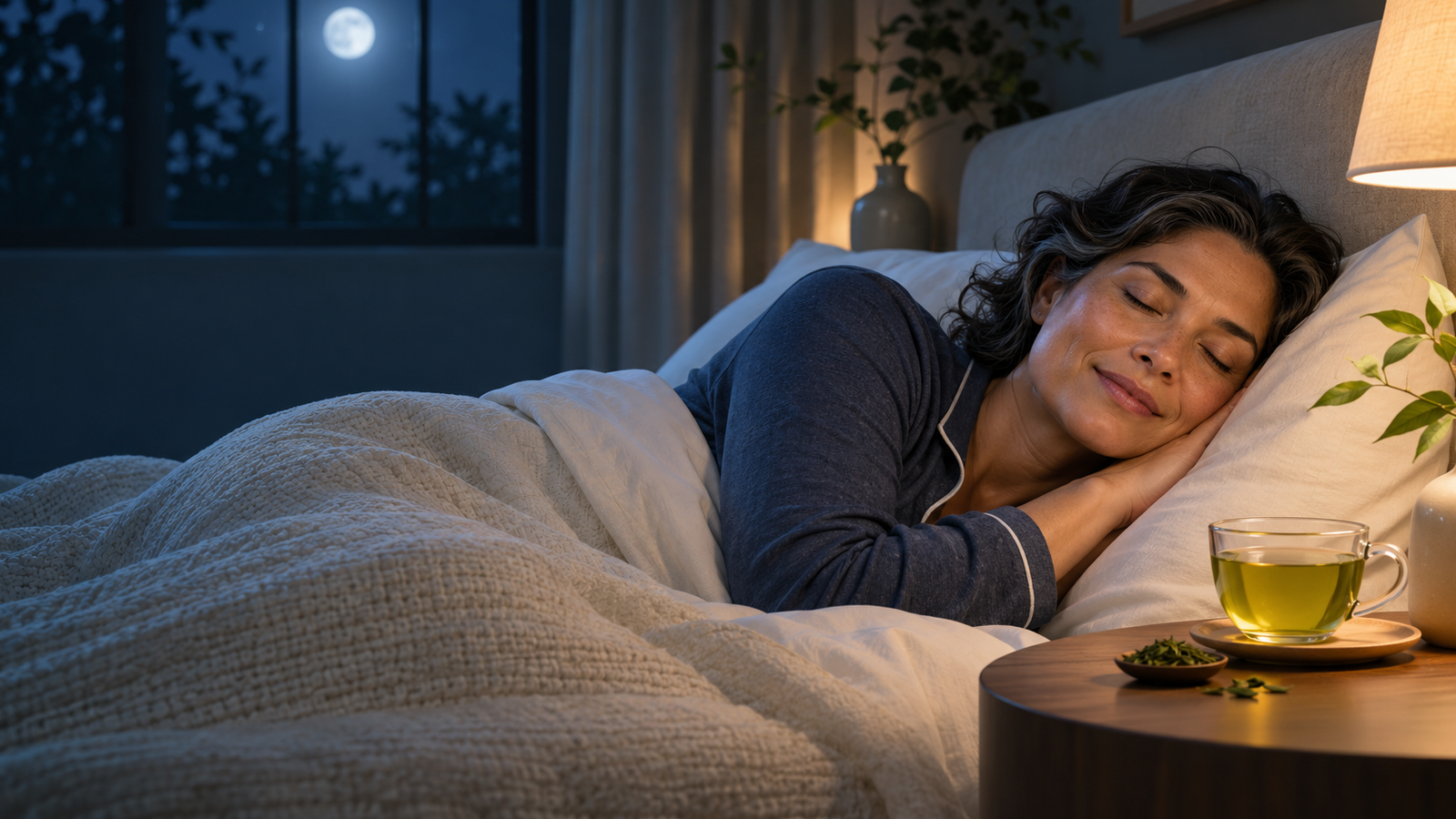
Quick answer: L-theanine may modestly improve how people rate their sleep quality and how quickly they feel they fall asleep, but it is not a proven treatment for insomnia. Research is promising rather than conclusive, and objective sleep measurements have been less consistent than self-reported benefits.
Editorial and affiliate disclosure: This educational article is independently researched. It links to product reviews on this website that may contain affiliate links. We may earn a commission if you purchase through those links, at no additional cost to you.
L-theanine is an amino acid naturally found in tea leaves. It is often promoted as a calming supplement that supports relaxation without acting like a strong sedative. That distinction has made it popular among people who feel mentally alert at bedtime but do not want the stronger effects associated with sleeping pills.
Interest is rising quickly, but popularity is not the same as proof. This guide separates what human research suggests from what supplement marketing often claims, explains the doses used in studies, and compares L-theanine with melatonin.
What is L-theanine?
L-theanine is a non-protein amino acid found mainly in green and black tea. Unlike caffeine, it is not a stimulant. Laboratory and human research suggests it may influence brain signaling associated with relaxation and attention, although its exact sleep-related mechanism is not fully established.
A cup of tea provides much less L-theanine than a typical supplement. Tea also contains caffeine, which can interfere with sleep when consumed late in the day. Therefore, results from concentrated L-theanine supplements should not be assumed to apply to ordinary tea.
Does L-theanine help with sleep?
The best current summary is: possibly, but the effect appears modest and the evidence has important limitations.
- A 2025 systematic review and meta-analysis included 19 articles and 897 participants. It found small improvements in self-reported sleep-onset latency, daytime dysfunction and overall subjective sleep quality.
- The same review noted that many studies used combination products rather than pure L-theanine, making it difficult to know how much benefit came from L-theanine itself.
- Objective measures such as actigraphy and sleep-stage data have not been as consistently positive as participants’ own ratings.
- There is not enough evidence to consider L-theanine a treatment for chronic insomnia or another diagnosed sleep disorder.
In practical terms, L-theanine may be more relevant for occasional restlessness or a busy mind than for an underlying medical sleep problem. Persistent insomnia, loud snoring, gasping during sleep, restless legs or severe daytime sleepiness deserve professional evaluation.

L-theanine vs melatonin: what is the difference?
| Feature | L-theanine | Melatonin |
|---|---|---|
| What it is | An amino acid found in tea | A hormone produced by the body |
| Main role | May support relaxation and perceived sleep quality | Signals biological night and helps regulate sleep timing |
| Best-supported use | Possible support for occasional stress-related sleep difficulty | Jet lag, circadian timing problems and selected sleep-onset situations |
| Typical study approach | Often 200–450 mg daily, though no standard sleep dose is established | Lower doses are often sufficient; needs vary by purpose |
| Common concern | Limited long-term and product-specific evidence | Next-day drowsiness, vivid dreams and inconsistent supplement content |
Melatonin and L-theanine are not interchangeable. Melatonin acts mainly as a timing signal, while L-theanine is marketed for calmness. Some formulas combine them, but evidence for each ingredient does not automatically prove that a specific blend works.
For a broader comparison, see our guide to melatonin vs magnesium for sleep.
How much L-theanine is used for sleep?
There is no officially established L-theanine dose for insomnia. Reviews of adult studies commonly discuss doses in the range of 200–450 mg per day, but study designs, populations and product combinations vary. That range should not be treated as a personal prescription.
If a clinician agrees that a supplement is appropriate, use a product with a clearly disclosed amount and follow its label. Avoid proprietary blends when you need to know exactly how much L-theanine you are taking. More is not necessarily better, and long-term safety data remain limited.
When should it be taken?
Many supplement labels suggest taking L-theanine 30 to 60 minutes before bedtime, but research does not establish one universally effective schedule. Consistent sleep habits are more important than relying on the exact minute a supplement is taken.
Start with the basics: keep a regular wake time, reduce bright light late at night, avoid caffeine in the afternoon or evening, and give yourself a realistic wind-down period. Our guide explains how to fix your sleep schedule naturally.
Possible side effects and interactions
L-theanine has generally been well tolerated in small human trials, but that does not mean it is risk-free for everyone. Reported or possible concerns include headache, stomach upset, dizziness, sleepiness and changes in blood pressure. Supplement quality and dose also vary between products.
Speak with a healthcare professional before using L-theanine if you:
- take sedatives, sleep medicines or other products that cause drowsiness;
- use blood-pressure medication or tend to have low blood pressure;
- are pregnant or breastfeeding;
- are receiving cancer treatment or take multiple prescription medicines;
- have a diagnosed sleep, anxiety or mood disorder;
- are considering giving it to a child.
Do not drive or operate machinery until you know how a new supplement affects you. Combining several calming ingredients can increase drowsiness even when each ingredient seems mild on its own.
What to look for in a sleep supplement
- Transparent amounts: Every active ingredient should have a listed dose.
- Third-party testing: Prefer products tested for identity, purity and contaminants.
- Realistic claims: Avoid products promising to cure insomnia or guarantee deep sleep.
- Low complexity: A shorter ingredient list makes effects and side effects easier to evaluate.
- Clear return policy: Read the actual terms before buying.
Considering a multi-ingredient sleep formula?
YuSleep includes L-theanine alongside melatonin, magnesium glycinate and other ingredients. Our independent review examines the label, evidence, limitations, safety considerations and buying questions.
Frequently asked questions
Does L-theanine make you sleepy?
It is generally described as calming rather than strongly sedating. Some people may still feel drowsy, especially when it is combined with sleep medicines or other calming supplements.
Can you take L-theanine every night?
Short studies suggest reasonable tolerability, but long-term nightly safety is not well established. Discuss regular use with a clinician, particularly if you take medication or have a health condition.
Is L-theanine better than melatonin?
Neither is universally better. Melatonin is more directly related to circadian timing, while L-theanine may support relaxation. The appropriate choice depends on why sleep is difficult.
Can L-theanine treat insomnia?
No supplement should be presented as a proven treatment for chronic insomnia. Cognitive behavioral therapy for insomnia is the first-line treatment for many adults, and persistent symptoms should be evaluated by a qualified professional.
Bottom line
L-theanine is a promising but not definitive sleep-support ingredient. Current evidence suggests small improvements in subjective sleep quality for some people, while the ideal dose, duration and long-term safety remain uncertain. Treat it as an optional addition to healthy sleep habits—not a substitute for diagnosis or evidence-based care.
Sources
- Bulman A, et al. The effects of L-theanine consumption on sleep outcomes: a systematic review and meta-analysis. Sleep Medicine Reviews. 2025.
- Payne A, et al. Effects of tea, L-theanine or L-theanine plus caffeine on cognition, sleep and mood. Nutrition Reviews. 2025.
- Memorial Sloan Kettering Cancer Center: L-Theanine—uses, safety and interactions.
- U.S. FDA Pharmacy Compounding Advisory Committee materials: L-theanine evidence and safety review.
Last reviewed: November 11, 2026. This article is for general education and is not medical advice.