
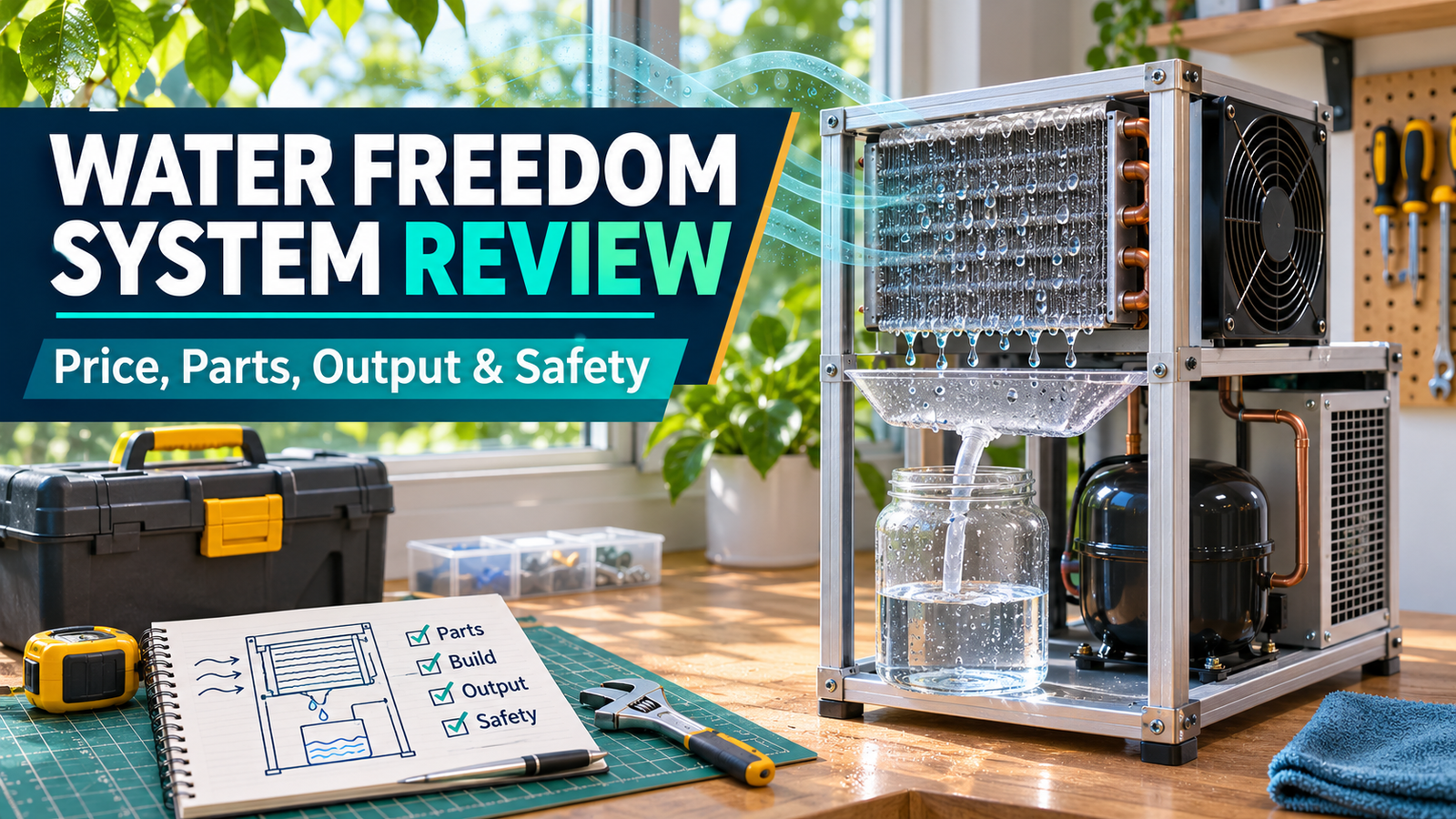
Prices, availability and refund terms can change. Verify them on the official page.
Quick verdict: Water Freedom System is an instructional product—not a ready-made water machine. It provides digital PDFs and videos for a do-it-yourself atmospheric water collection project, with a physical-book option also referenced by the seller. The underlying condensation technology is real, but output depends heavily on humidity, temperature, design and electricity use. Collected water also requires appropriate treatment and testing before anyone considers drinking it.
Affiliate disclosure: This independent Water Freedom System review contains affiliate links. If you purchase through them, we may earn a commission at no additional cost to you. We did not build or laboratory-test the seller’s design, we do not claim personal results, and the seller did not review or approve this article.
Water Freedom System is marketed to people interested in emergency preparedness, off-grid living and do-it-yourself projects. The offer centers on instructions for assembling a device that condenses moisture from the air. That sounds dramatic, but the basic process is familiar: many commercial atmospheric water generators use cooled coils in a way that resembles a dehumidifier.
The important buying question is not whether condensation exists. It does. The real questions are whether the instructions match your skills and climate, what the parts and electricity will cost, how much water a specific build can realistically produce, and how you will treat and test the water.
Water Freedom System at a glance
| Product | Water Freedom System |
|---|---|
| Product type | DIY instructional program; not a finished appliance |
| Delivery | Digital PDFs and videos; the seller also references a physical-book option |
| Seller name used | Richard Wilson, identified by the sales page as a pen name |
| Retailer | ClickBank |
| Current price | The video funnel may not show the final amount immediately; current market checks place the digital offer around $39.69, but confirm the checkout total and any add-ons |
| Refund period | 60 days according to the official refund page; conditions apply |
| Additional costs | Parts, tools, electricity, replacement filters, maintenance and water testing |
| Independent validation | We found no third-party engineering or drinking-water certification for the exact DIY build |
What do you actually receive?
The seller’s help center says buyers receive PDF files and videos through a ClickBank access link. These materials are intended to guide the buyer through the project. A physical-book option is also mentioned in the seller’s shipping and refund information, although availability and shipping charges should be confirmed at checkout.
You are not buying a preassembled generator, a box of parts or a certified drinking-water appliance. You supply the components, tools, labor and ongoing maintenance. This distinction matters because the guide’s purchase price is only the beginning of the total project cost.
How atmospheric water generation works
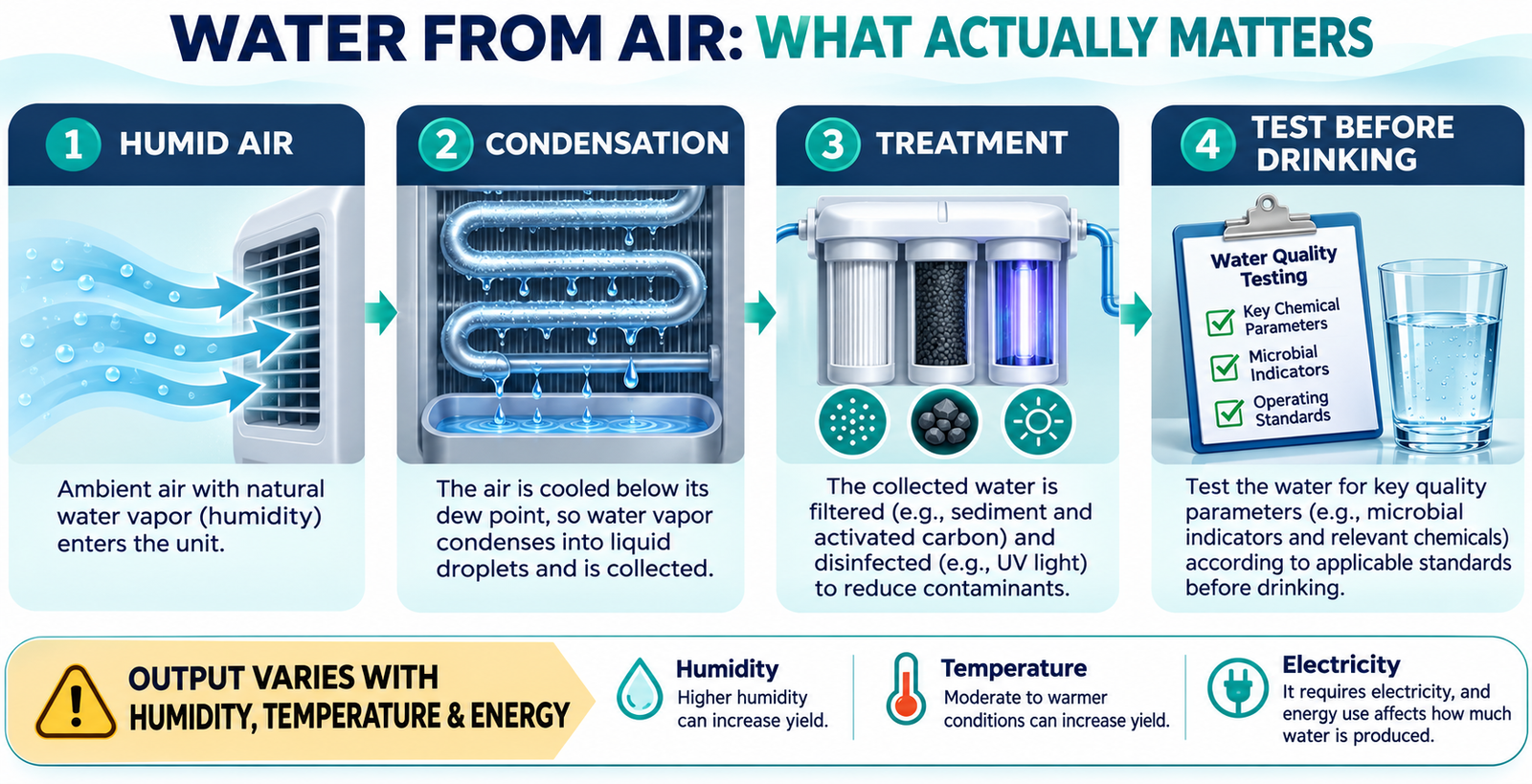
Atmospheric water generation extracts water vapor from air. In a condensation-based system, a fan moves humid air across a cold surface. Cooling the air below its dew point turns some vapor into liquid droplets, which can then be collected.
The U.S. Department of Energy notes that temperature and humidity affect how much water can be extracted. Energy requirements and cost also matter. A system in warm, humid coastal air will not behave like the same system in a dry inland climate.
Realistic output: why humidity changes everything
Any fixed gallons-per-day promise should be treated cautiously unless it includes the test temperature, relative humidity, power draw, machine capacity and operating time. The EPA says home-based atmospheric water generators commonly produce roughly 1 to 20 liters per day, while larger commercial systems can produce much more. That range describes tested technology generally; it does not validate the exact Water Freedom System design.
- Humidity: More water vapor is available in humid air.
- Temperature: Warmer air can hold more moisture, but cooling demands change.
- Airflow and coil capacity: A small system can process only so much air and heat.
- Operating time: Daily output depends on how long the unit runs.
- Maintenance: Dirty coils, filters or storage components can reduce performance and create hygiene problems.
DOE’s 2026 alternative-water guidance rates much of the dry western United States as having poor condensate-capture potential, while humid Gulf Coast, southern Florida and Hawaii conditions are more favorable. Before buying, check typical outdoor and indoor humidity where the device would operate.
The costs beyond the guide price
A useful budget should include every cost required to build and operate the project—not just the digital guide.
- Cooling, fan, frame, tubing, collection and storage components
- Food-contact-safe materials where water touches the system
- Filtration and disinfection equipment
- Tools and replacement parts
- Electricity measured in kilowatt-hours
- Filter, lamp and cleaning-supply replacement
- Appropriate laboratory or certified water testing
Atmospheric collection may be valuable when ordinary water access is disrupted, but EPA analysis has found that producing water this way can cost more in energy than obtaining water from a public supply. Buyers should calculate operating cost instead of assuming “water from air” means free water.
Is collected water automatically safe to drink?
No. EPA research warns that atmospheric condensate is not sterile. Airborne volatile compounds may enter the condensate, and microorganisms can grow in plumbing or stored water. Appropriate treatment, cleaning and testing are therefore essential.
The treatment approach must match actual risks. A sediment filter, activated carbon or UV unit does not automatically solve every possible chemical or microbial problem. Materials, local air quality, storage temperature, maintenance and system design all affect the result. Follow local public-health guidance and use a qualified laboratory when water is intended for drinking.
Water Freedom System versus common alternatives
| Option | Main advantage | Main limitation |
|---|---|---|
| Water Freedom System guide | Structured DIY instructions and videos | You must source, build, treat, test and maintain the system |
| Commercial atmospheric water generator | Purpose-built equipment and documented specifications | Higher purchase price; certification and performance still require checking |
| Household dehumidifier | Readily available condensation device | Its collected water is generally not intended or certified for drinking |
| Stored emergency water | Simple and immediately available during an outage | Limited quantity and requires rotation/storage space |
| Municipal water or tested well | Established everyday supply and oversight | Can be disrupted during disasters or infrastructure failures |
CDC recommends keeping at least one gallon of safe water per person per day for three days, and a two-week supply where possible. A DIY project should not replace that basic emergency reserve until it has demonstrated safe, reliable performance under your actual conditions.
Pros and limitations
Potential advantages
- Instant access to digital instructions
- May appeal to practical DIY and preparedness readers
- Based on a real condensation principle
- PDF and video formats provide different ways to learn
- Official page states a 60-day refund window
Important limitations
- Not a finished or independently certified appliance
- Parts and operating costs are separate
- Output varies substantially by climate and design
- Condensed water requires treatment and testing
- We found no independent test of the exact DIY build
Who may find it useful?
The guide may suit an experienced, safety-conscious DIY reader who understands that this is a project rather than a plug-and-play solution. It is more plausible in a humid climate with reliable electricity, access to suitable parts and a realistic water-treatment plan.
Skip it if you want a certified appliance delivered to your home, live in a very dry climate, lack the required tools, or need an immediately dependable emergency supply. Anyone relying on generated water for drinking should obtain appropriate professional and laboratory guidance.
Price, checkout and 60-day refund policy
The sales presentation is a video funnel and may not reveal the final price immediately. Current market checks place the digital offer at roughly $39.69, but the authoritative amount is the total shown on the ClickBank checkout page. Review every selected item, optional upgrade, recurring charge and shipping fee before submitting payment.
The official refund page states that digital orders have a 60-day money-back guarantee. It also describes refund choices for physical-book orders and says shipping and handling are not refundable. Save the receipt and use the exact terms shown for your transaction.
For another home-resilience digital offer, see our Energy Revolution System review. It addresses electricity rather than water, but the same buying rule applies: separate an instructional guide’s price from the cost, safety and performance of the physical project.
Considering Water Freedom System?
Confirm the current price and refund terms, then budget for parts, power, treatment and testing. Buy only if you are comfortable treating it as a DIY learning project—not a guaranteed source of free or automatically drinkable water.
Frequently asked questions
Is Water Freedom System a physical machine?
No. The core product is instructional material delivered as PDFs and videos. The seller also references a physical-book option, but buyers supply the machine components.
Does atmospheric water generation really work?
Yes, atmospheric water generation is a recognized technology. That does not prove a particular DIY design’s output, safety or economics. Humidity, temperature, equipment capacity, energy use and treatment determine the result.
How much water will the system make?
No responsible estimate can be given without the local climate and a tested build specification. Treat large output numbers as marketing claims unless they include documented test conditions and independent measurements.
Can you drink water collected from air?
Not automatically. EPA research shows atmospheric condensate is not sterile and may support microbial growth or contain airborne contaminants. Suitable treatment, cleaning and testing are necessary before potable use.
What is the refund period?
The official refund page states 60 days from purchase. Digital and physical-book conditions differ, and shipping charges may not be refundable.
Final verdict
Water Freedom System packages a real scientific concept into a consumer DIY guide. That may be useful for a capable hobbyist who wants structured instructions and accepts the additional cost and safety work. The technology should not be confused with proof of the exact design, and condensed water should never be assumed safe. Judge the guide as educational material, calculate the full project cost, and keep a conventional emergency water supply.
Sources
- U.S. EPA: Atmospheric Water Generation Technology technical brief.
- U.S. EPA: Evaluation of Atmospheric Water Generation Technology Microbial Water Quality.
- U.S. Department of Energy: Alternative Water Sources and Atmospheric Water Generation.
- U.S. Department of Energy: Alternative Water Supply Tool Help Guide.
- CDC: Cistern Safety and Emergency Water Supply Guidance.
- Water Freedom System official refund policy.
- Water Freedom System official help center.
Last reviewed: November 14, 2026. This article provides general consumer education and does not provide engineering, drinking-water, medical or emergency-management advice.